2024

May 10th
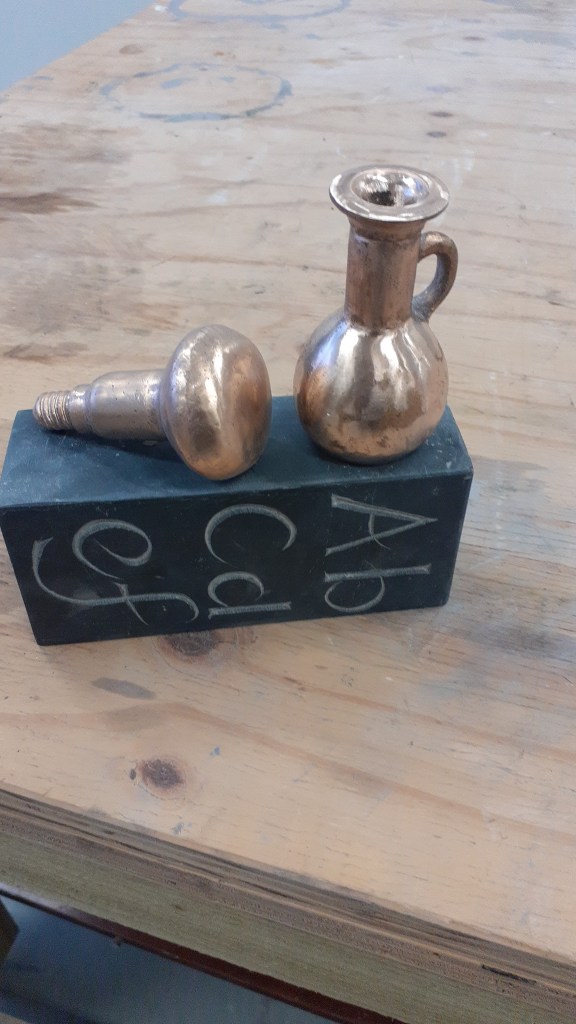
Marble and bronze. Writing? Music? Could I make a sort of Rosetta stone with different “scripts”?


Studies for Figures at the Base of a Crucifixion.
It is now 80 years since Bacon painted “Three Studies……” in 1944. It is a hugely important in the history of British painting and it had a huge effect on me personally when I first saw it in 1968. When Bacon painted it rumours were emerging of concentration camps in Germany. Bacon’s nihilistic mindset and enjoyment of sexual violence reinforced each other to produce a truly compelling image. I am drawn to trying to update the image but without the visceral violence and without the theatricality.
I am however looking for a sense of the random and the totally irrational. I want to invent a space where individuals can be instantaneously wiped out as is happening in israel/Palastine or in Ukraine and a dozen other conflicts around the globe. One minute you can be a fully functioning sentient being and the next chunks of rotting meat. For the most part neither the killer or the killed do not know each other.
Perhaps, I can make a sculpture of fragments. And perhaps I can make an image that is less overtly masculine than Bacon. I want images of fragility of men, women and children of various ages. I want to depict them naked to emphasise their common humanity, beauty and vulnerability. I intend to place them in a dangerous and unpredictable context.


28th July
I am starting to plan for a project in the future which will be a memorial to my gt,gt,gt,gt grandfather William Kinghorn who died in 1794 at the age of 61 and is buried in the Old Calton Burial Ground. William was a master mason from Ormiston who moved to Edinburgh with his wife Margret Grant. William was engaged in the building boom that was taking place at the time. Many of William’s descendants carried on as mason/ builders, later on branching out as contractors on lighthouses, the Leith Docks and, in the case of William’s grandson (also named William), contractor for the early railway lines.

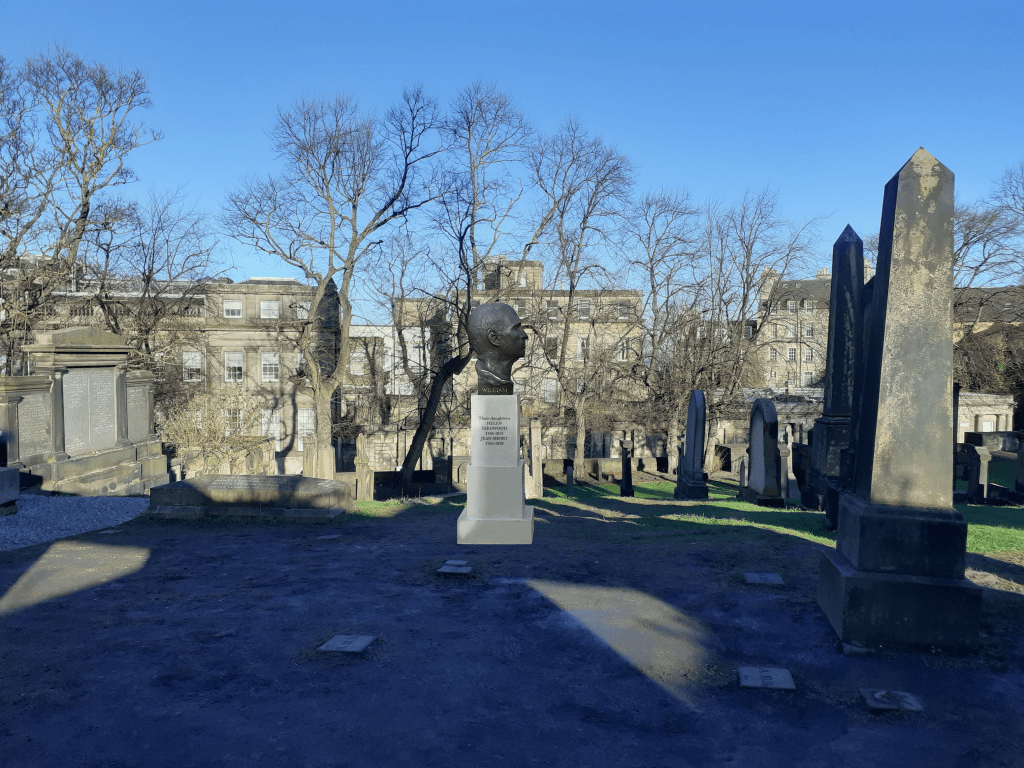
He is buried at the spot marked by a piece of plywood in the foreground. Around him on either side are two further lairs which constitute the family burial ground. In it are the bodies of William’s wife and four of his five children including my gt,gt,gt grandfather James Kinghorn.
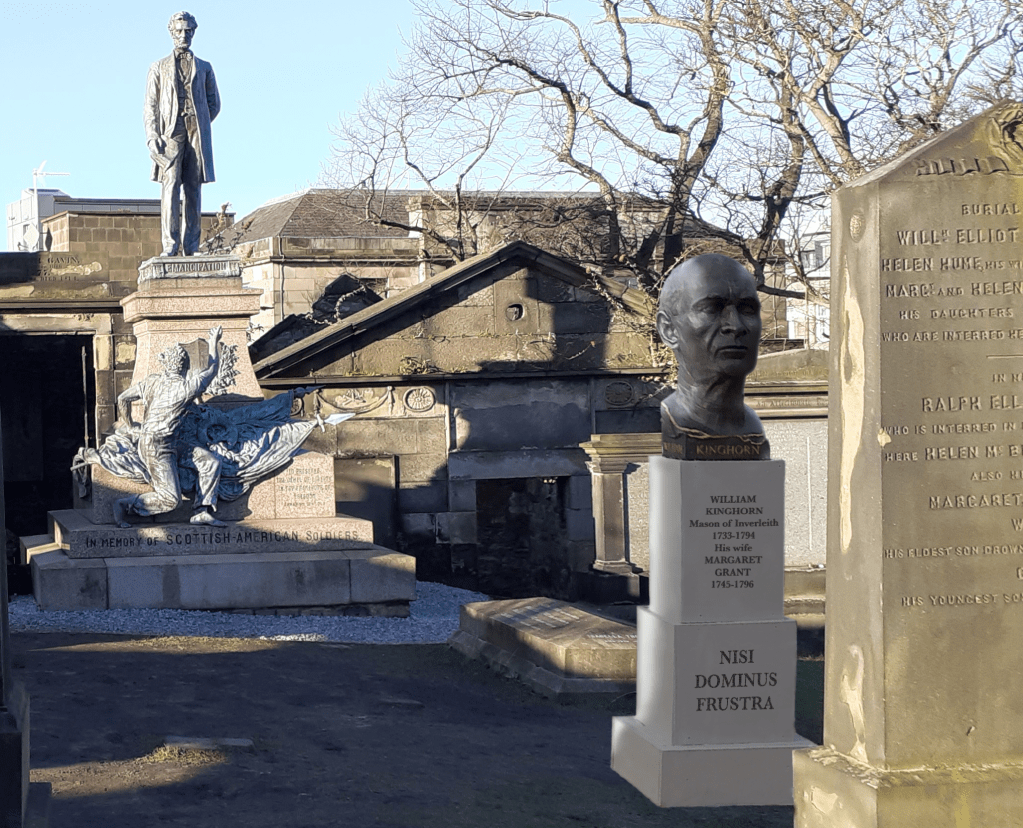
The site itself is in the epicentre of Enlightenment Edinburgh. In the background is the monument to the philosopher David Hume. Behind and to the left of the camera is the memorial is the monument to the painter David Allan. Whilst adjacent to Hume’s oculus is the memorial to the American Scots who died in the American civil war.
I hope to mark this family grave site with a bronze bust on top of a sandstone column as in the mock up in my studio.


The last family member was interred over 150 years ago. By this time there should be no further settlement to the earth and it should be possible to make a firm foundation for the base of the monument.
The project is still at the planning stage and our immediate concern is proving to Edinburgh City Council that this site belongs to us. I have provided them with an ascending family tree demonstrating our ownership. After that we will need to demonstrate that our memorial is in keeping with it’s surroundings. The site has UNESCO World Heritage Listing so we will need to show that we are contributing to the site rather than diminishing it.
Lots of hoops to jump through till this project comes to fruition.
28th August 2024
Edinburgh City Council Now has accepted that we own the site. They are in discussion with Planning and Edinburgh World Heritage. I have offered to make a more formal application.
The bronze head has now had a bronze base plate welded to it with 15mm A4 stainless rods projecting 100mm to be fixed with resin the to the stone. The bronze is now with Mark the sandblaster prior to repatinating it.
I have also reworked the mockup plinth. I need to reattach the head to the base and then consider the relationship between the two. One of the problems with siteing sculpture outside is that it tends to look tiny when measured against other memorials. I want the image to have some gravitas but I certainly do not want to claim more status for William than he deserves. He is in very rarified company as it is.
There now appears to be eight or perhaps nine family members buried in the three lairs. My cousin Sheena is working out the exact numbers. There will be a lot of letter cutting! I am rather siding with Hume’s view that the inscriptions should be short – just names and dates.
Repatinating the bronze


The base stone needs to be wider and deeper. The edges of the tiers also need to be chambered to discourage rain water from pooling. The text will fit into the space and still be legible at this scale. The stone also needs a Latin tag. NISI DOMINUS FRUSTRA is the abbreviation of psalm 127 which is a psalm appropriate for a family of builder/ masons and is coincidently the motto of the City of Edinburgh.
There are several issues to resolve. First the right sized monument- it is important not to rock the status quo by erecting a monument that is too big for the status of the buried. Then the style of a memorial then the colour of the bronze. Then the size of the inscriptions and the font and so on. There are also assumptions about Patriarchy which I have taken as a given. Ergo the emphasis on William K. I primarily want to depict a 61 year old mason of a generic Scotish type. I also wanted to depict a practical man without fripperies like a wig.
The fact that there are up to nine members of the family buried in plot suggests that we need a reasonably substantial memorial if only for space for inscriptions. But I do wonder if this is too substantial. Perhaps, I am paranoid but so many grave stones in Edinburgh have been pushed over either by the council or by vandals that I want the memorial to be solid enough to survive every eventuality.

D O Hill’s memorial at the Dean Gallery. I like the stepping ratio of the three stones that go to make this up. The bronze is by Amelia Paton/Hill.

The whole point with the Old Calton Burial Ground site is that it is on top of a steep flight of stairs. This means that a single large stone is impossible to move up the slope. Thus the decision for the three stones. Even then the weight limitation for the Caterpillar tracked moving machinery is 340 kg. It makes moving a large stone (like the one at the base of Hill’s memorial) impossible. The heaviest stone in the wooden mockup is 250kg so it is well within the capabilities of the stair climber needed.
This project is on hold until I get the necessary permission.
In early December we were informed that permission was refused because of the site’s proximity to the the memorial to the Scots who fought in the American Civil war.
There were two issues that EWHT objected to firstly the size of the memorial at 2m it was too big and secondly William K’s lair is at the centre of the three of the family plot and by locating the memorial directly over his remains it obstructed views of other monuments. However if our memorial is moved three foot to the North so that it is sited over my gt, gt, gt grandfather’s lair then the obstruction of the view is minimised. We intend to resubmit.
Photoshop views of burial ground looking West and North.


Broken bronzes.
I am not quite sure why but I am rather enjoying the random nature of destruction. Recently I have been smashing up bronze plates and bowls. The only way to authentically ‘break’ bronze is to heat it up till it is nearly red hot and then smash it with a hammer. This way the fracture most resembles broken porcelain or pottery. This project is mostly about celebrating things that are not quite perfect – much like the Japanese philosophy of kintsugi.


The the plates now need to be patinated, gilded and powdercoated.


Reminiscences of talking gently away as we walked on the beach at Yellowcraig.
The sea and sky. The light. Our interlinking voices….

with Simon Burns-Cox
2025
Boats from Little Sparta.


We bought these at auction largely on the basis of the label. They are Ian Hamilton Finlay’s model boats that he sailed on Loch Eck at Little Sparta.

We were worried about two things when acquiring these. First whether they were really Ian’s and secondly whether they had been stolen at some stage. The problem we had was with the label. The letters GMA stand for the Gallery of Modern Art and the numbers are made when they fell under the control of the gallery. We have since discovered cast iron provenance. Phew.
Railings for 31 Bellfield Street.
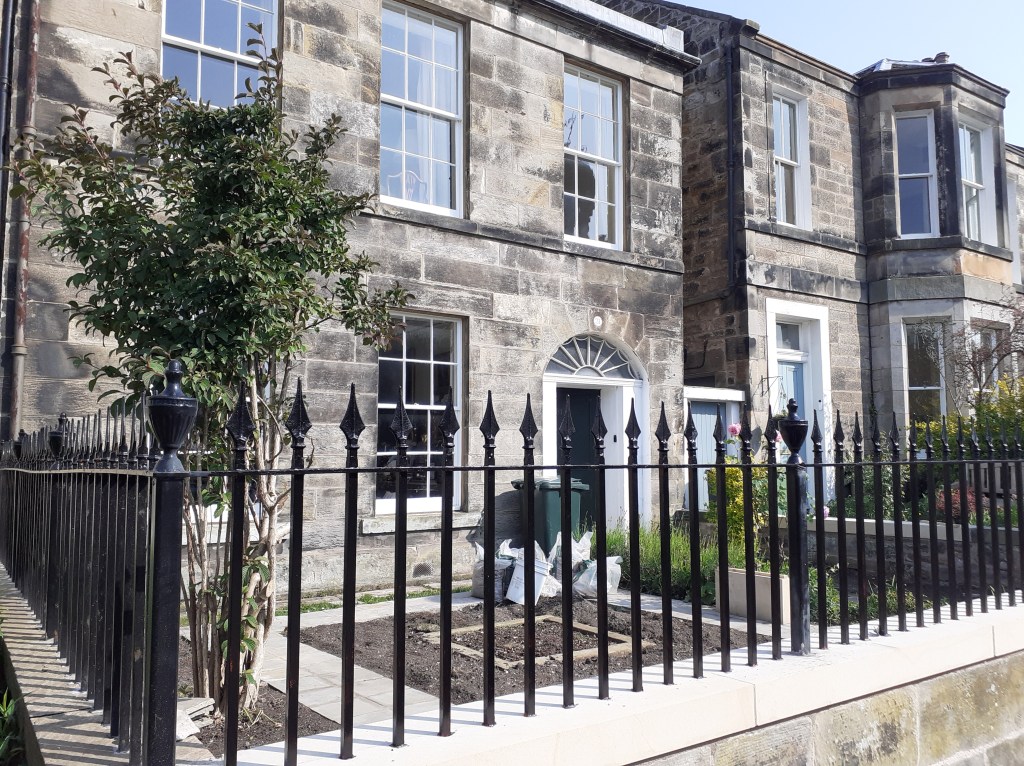
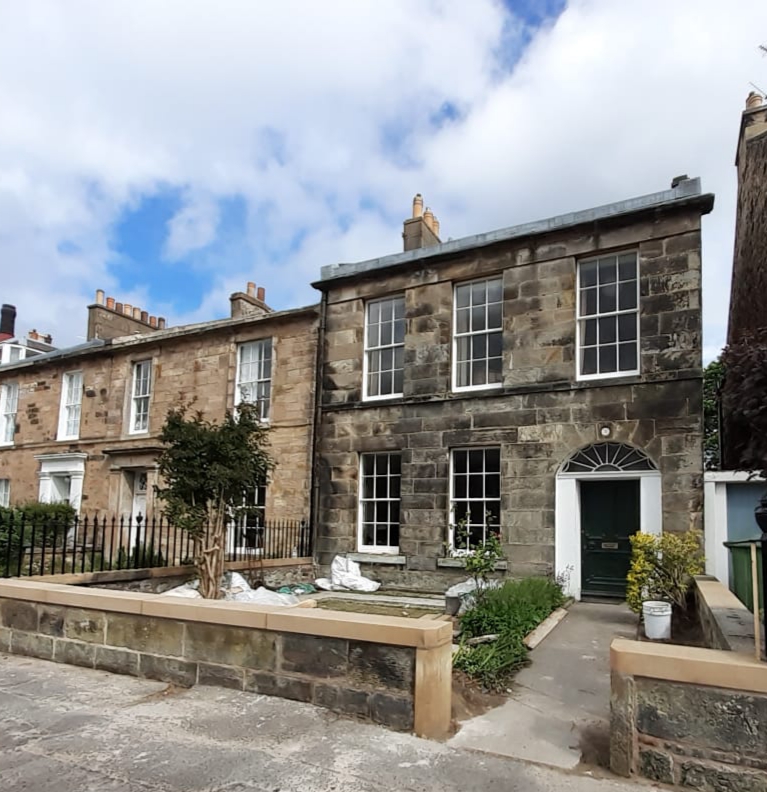
After 35 years of living in our house I have finally got round to replacing the railings in our garden. It is a job that has grown as I have gone along since I have discovered that when the original 1820 railings were removed in 1939/40 to support the war effort the coping stones were damaged. All of them now need to be replaced too.


Front and side walls rebuilt and coping stones replaced. A path of stone paving has been laid and the earth has been leveled. Only the railings and the planting to go. All the railing components have already been fabricated.